Metal roofing: our specialty
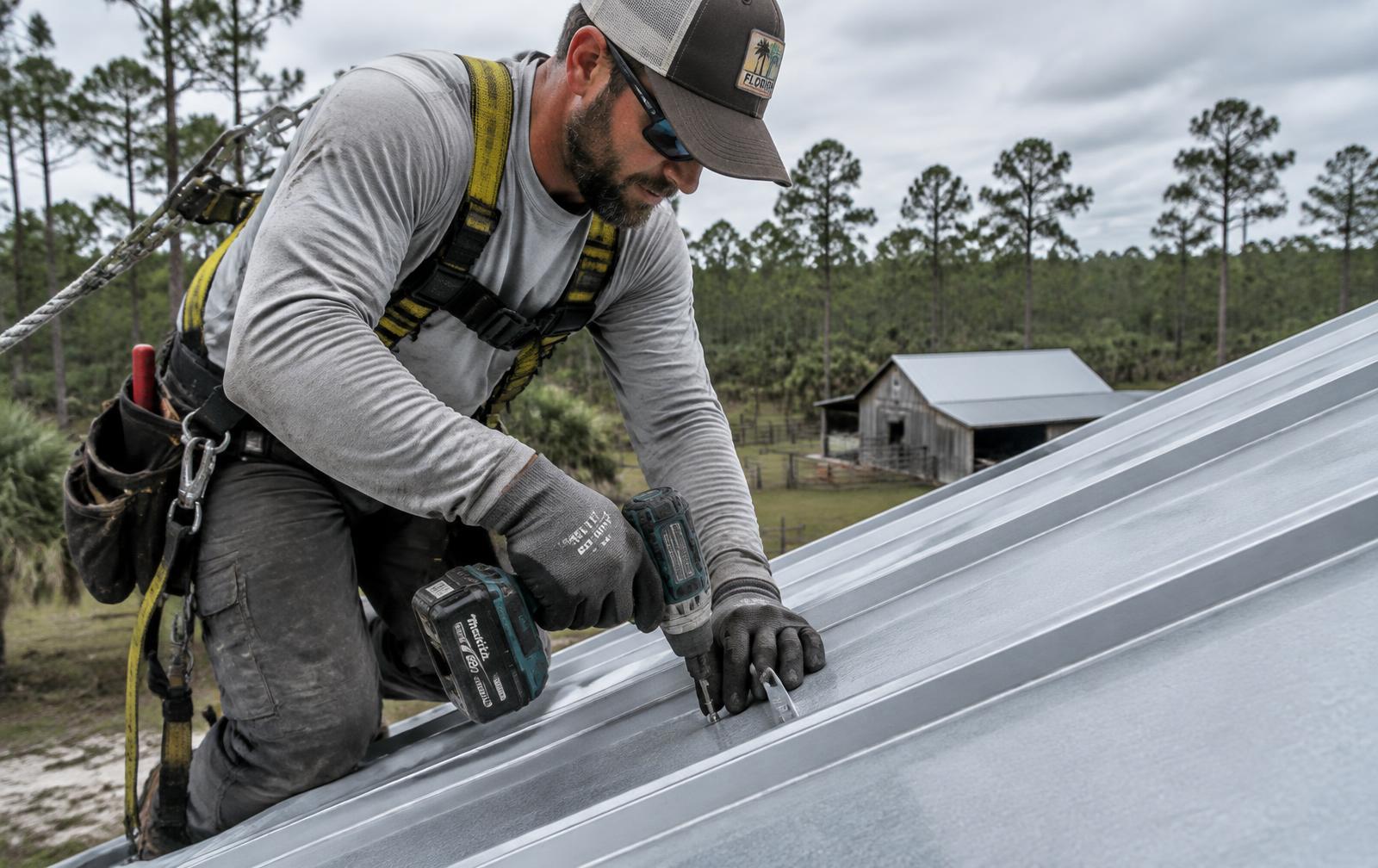
Drive any back road between Live Oak and Trenton and you'll see why metal is so common here. It sheds rain fast, it doesn't curl in the heat, and pine needles slide off instead of packing into the valleys. Metal is the system Jay knows best, and it's the one we recommend most often for homes, barns, and shops on acreage.
Standing seam
Standing seam panels run from eave to ridge with raised, interlocking seams. The clips that hold them down sit underneath, so there are no exposed screws to back out or wash out over time. It's a clean look on a house and it moves freely as the metal expands and contracts through hot afternoons and cool nights.
Exposed-fastener panels
Exposed-fastener panels — 5V crimp, R-panel, and similar profiles — go down with gasketed screws through the face of the sheet. They're the workhorse of North Florida agriculture: pole barns, hay sheds, equipment covers, and workshops. Installed with the right fastener pattern, they're a tough, cost-effective roof. We pay attention to screw placement and torque, since over-driven or crooked screws are where most of these roofs start leaking.
For a deeper look at panel profiles, coatings, condensation, and re-screwing older metal, see our metal roofing page.
Architectural shingles
Not every house wants metal, and plenty of subdivisions in Clay, Duval, and Columbia counties are built around shingle roofs. Architectural (dimensional) shingles are thicker than old three-tab and better suited to our wind. We follow the manufacturer's high-wind nailing pattern, install proper starter strips at eaves and rakes, and use underlayment that keeps water out if a few tabs are lost in a storm.
Flat and low-slope sections
Porches, carports, additions, and commercial buildings often have sections too flat for shingles or standard panels. Water sits longer on those areas, so material choice and detailing at walls and drains matter. We'll tell you what system fits the slope and how the transition to the main roof should be handled.
Repair or replace?
We don't push a new roof when a repair will hold. A damaged pipe boot, a few blown-off shingles after a thunderstorm, or a panel lifted at the eave can usually be fixed in a day. When the decking is soft, leaks keep popping up in new places, or the shingles are shedding granules across the whole slope, patching becomes throwing money at the problem. You'll get photos and a plain explanation either way.
Our roof repair page covers leak tracing, flashing, and storm dry-in, while roof replacement walks through a full tear-off from permit to final walkthrough.
Storm damage and insurance documentation
The Big Bend and Suwannee Valley have taken real hits — Hermine, Idalia, and Helene all pushed damaging wind well inland, and spring squall lines can spin up tornadoes with little warning. After a storm, we inspect the roof, photograph the damage, measure the affected areas, and put it in writing. If you file a claim, that record gives your adjuster something concrete. We can also tarp or make temporary repairs to stop water while the claim is worked out.
Building code and wind mitigation
Every roof we install is permitted and built to the Florida Building Code, which sets wind-resistance requirements for decking attachment, fasteners, and underlayment. Many of those same details show up on the state's wind mitigation inspection form. Homeowners who have a qualified inspector complete that form after a reroof can often see a reduction in the wind portion of their insurance premium. Ask us about the details that matter for your house.
Homes, farms, and commercial roofs
Our work ranges from single-family homes to agricultural buildings and small commercial properties. Barns and shops have different priorities than a house — clear spans, ventilation for stored equipment and hay, and keeping cost per square foot reasonable — and we price and plan them accordingly. If you need the whole building and not just the roof, we also put up metal-roofed pole barns from the posts up.
Five14 Construction is run by a state-certified roofing contractor, license CCC1336952, and carries insurance. You'll deal with the owner from the first visit to the final walk-through.