Material choices for this region
Vinyl
Budget-friendly and never needs paint. It flexes rather than cracks, but quality varies a lot by thickness, and it needs room to expand in summer heat.
Fiber cement
A cement-based board that resists rot, termites, and fire. Comes in lap siding, board-and-batten panels, and shingle styles, and takes paint well. Heavier and slower to install.
Engineered wood
Wood strands bonded with resins and a protective overlay. Lighter than fiber cement with a real wood look; it needs sealed cut edges and good paint.
Metal
Steel panels like the ones on pole barns and shops. Very durable against impact and pests, and the natural match for a metal roof.
Product lines we install: [PLACEHOLDER: siding brands/lines].
What our climate does to an exterior wall
Humidity and mildew. Walls that never fully dry grow mildew and algae, especially on the shady side of the house and under live oaks. On wood-based siding, trapped moisture leads to swelling and rot.
Termites. Siding that runs down to the soil gives termites a hidden highway into the framing. We keep a gap between the bottom course and grade so the foundation stays visible for inspection.
Wind-driven rain. During a squall line or tropical storm, water is pushed up and sideways behind laps and trim. That's what the layers behind the siding are for.
The layers you never see
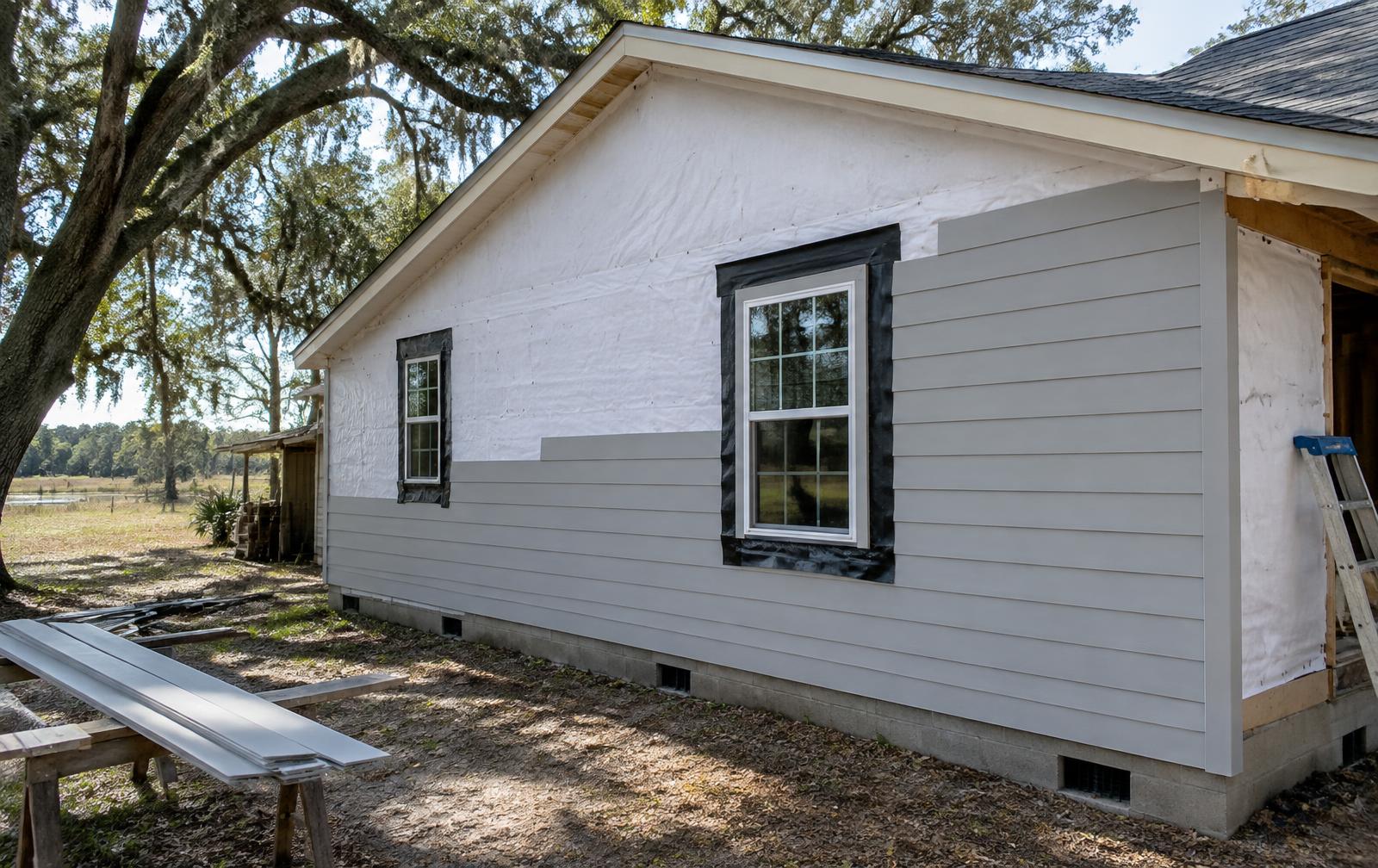
The weather-resistive barrier — house wrap or a similar membrane — is lapped shingle-style so water running down it always lands on the outside of the layer below. Windows and doors get flashed in the correct order: sill pan first, then sides, then head flashing over the top, all integrated with the wrap. Kick-out flashing goes where a roof edge dies into a wall, a spot that rots out on many Florida homes. Skipping these steps is how a house with brand-new siding still ends up with rotten sheathing.
Storm damage and matching what's there
Flying debris cracks vinyl, wind peels loose courses off, and a fallen limb can punch through fiber cement. For partial repairs we identify the profile and exposure, then source the closest match available. Where an exact color isn't made anymore, one option is to move original siding from a less visible wall to the damaged front and put the new material in back. If the wall behind is wet, we check sheathing and framing before closing it up.
Curb appeal and comfort
New siding changes how a house looks from the road more than almost any other project — board-and-batten on a farmhouse gable, crisp lap on a ranch home, or metal to tie a shop into a metal-roofed house. While the walls are open, it's also the right moment to seal air gaps around penetrations and consider insulated sheathing.
Got a wall that needs attention? Start Your Quote, and if the roof above it needs work too, take a look at our roofing services.